Cookies help us deliver our services. By using our services, you agree to our use of cookies.
Carbon Fiber Rod
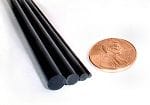
DragonPlate Carbon Fiber Rods are exceptionally straight and rigid, making them an ideal building material for frames, trusses, and for use as reinforcing material.
Carbon fiber is extremely strong. The modulus of carbon fiber is typically 33 msi (228 GPa) and its ultimate tensile strength is typically 500 ksi (3.5 Gpa). Because of this, Carbon Fiber Rods have become fundamental building blocks in the building of high-performance structures and work well in concert with DragonPlate Carbon Fiber Laminate
DragonPlate Carbon Fiber Rods are pultruded in an epoxy matrix and will bond readily with ScotchWeld 2216 epoxy resin.
Need to connect our 0.5" carbon rods together? Check out our Pultruded Molded Connectors.
Sort by
Display per page
SKU | DESCRIPTION | LENGTH | PRICE | ||
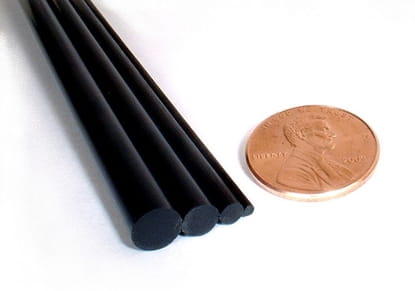 FDPR.315*48 | DragonPlate Carbon Rod ~ 8mm x 48" | 48" | From $18.52 |
| ||||||||||||
Carbon Fiber Rods — Buyer's Guide
Choosing a Rod
DragonPlate® carbon fiber rods are pultruded in a carbon fiber epoxy matrix, pulled through a heated die in a single 0° direction, which is what makes them exceptionally straight and rigid. Unlike a tube, a rod is a fundamental building block rather than a hollow structural member: it is the reinforcing strip, the stiffening spar, or the connector shaft in an assembly that also uses sheet, tube, or structural-component stock. Choosing a rod comes down to one variable — outside diameter — since every DragonPlate® rod shares the same construction, fiber modulus, and mechanical properties. Pick the diameter your stiffness and load requirement calls for, then work back from there to length and connector compatibility.
What are the mechanical properties of DragonPlate® carbon fiber rods?
DragonPlate® carbon fiber rods are fabricated from carbon fiber with a modulus of 33 Msi (228 GPa) and an ultimate tensile strength of 500 ksi (3.5 GPa) — standard-modulus carbon fiber, pultruded rather than woven, which is what gives the rod its axial stiffness and straightness. Maximum service temperature is 200°F. Because the fiber runs unidirectionally (UD 0°), these properties apply along the rod's long axis; rods are not the right choice where the load case includes significant off-axis bending or torsion — a braided or roll-wrapped tube is the better fit there.
What sizes are available?
DragonPlate® stocks round rods from 0.020" up through 0.750" in outside diameter, in 24" and 48" standard lengths. Larger or custom diameters, and custom lengths, are available through Element 6 Composites.
Frequently asked selection questions
When should I use a rod instead of a pultruded tube?
Use a rod where the member is solid by design — a stiffening spar embedded in a sandwich panel, a reinforcing strip bonded into a laminate, or a connector shaft — rather than where weight reduction from a hollow section matters. A pultruded tube gives you the same straightness and axial rigidity at a fraction of the weight for a given outside diameter, so for a free-standing structural member, tube is almost always the better choice; rod earns its place when the application specifically calls for a solid cross-section.
Can I connect rods together, or to other structural members?
Yes. DragonPlate®'s 0.5" carbon rods are compatible with Pultruded Molded Connectors, engineered specifically to join rods of that diameter into modular assemblies without machining. For other diameters or custom connection geometries, Element 6 Composites can specify a bonded or custom-molded joint.
What adhesive should I use to bond carbon fiber rods?
DragonPlate® rods are pultruded in an epoxy matrix and bond readily with 3M Scotch-Weld 2216 B/A epoxy — the same adhesive system recommended for DragonPlate® tube and sheet products. For alternative bonding requirements, DragonPlate®'s adhesives and applicators line covers additional structural epoxy options.
Can I cut and shape rods myself?
Yes. Rods can be cut, drilled, and bonded with standard shop tools, without specialized composite fabrication equipment. As with other DragonPlate® pultruded products, use carbide tooling for CNC work, wind tape tightly around the rod before cutting to avoid fiber chipping, and follow standard carbon fiber dust precautions — safety glasses, respirator, ventilation, and HEPA capture.
What industries and applications use carbon fiber rod?
The rod is a fundamental building block across aerospace, robotics, industrial automation, medical devices, and defense — anywhere a straight, rigid reinforcing member is designed into a larger frame, truss, or laminate assembly. It's frequently specified alongside DragonPlate® sheet and tube products rather than as a standalone structural member.
Are rods available in flame-retardant, high-temperature, or hybrid Kevlar formulations?
Standard stock rod is rated to 200°F in standard-modulus carbon fiber. For elevated-temperature environments or impact-resistance requirements, DragonPlate®'s High Temperature and Kevlar Composites specialty lines are the better starting point — contact Element 6 Composites to confirm whether a rod-format custom solution is achievable for your application.
Ordering & Support
The listed price covers the rod itself — shipping, freight, taxes, and handling are calculated separately at checkout. Payment is prepaid by credit card, check, or wire; approved buyers may qualify for Net 30 terms. Bulk pricing is available by quote for larger orders.
Are DragonPlate® rods made in the USA?
Yes. DragonPlate® is a brand of Allred & Associates Inc., manufactured at the company's ISO 9001:2015-certified facility in Elbridge, New York, using first-quality materials only.
Support: 315-252-2559 (Mon–Fri, 8:30am–5:00pm ET) · service@dragonplate.com · Contact Us
Filter Products:
Price range
Length
Shape
Outside Diameter
Outside Diameter Range
Tube Finish
Ply Orientation
Max Temperature
Fiber Modulus
Composition
Recently viewed products